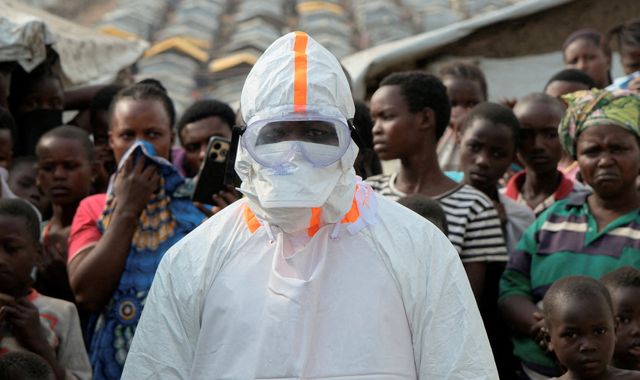
An Ebola outbreak in the Democratic Republic of the Congo (DRC) has officially become the deadliest in the country's history, data suggests.
The number of confirmed cases has risen to 4,945 - including 2,325 deaths - surpassing the 2,299 who were killed during a previous outbreak between 2018 and 2020.
On Friday, the UN's humanitarian affairs chief Tom Fletcher said "Ebola is winning in the Democratic Republic of the Congo" - adding that the epidemic was now killing one person every 30 minutes.
It had already become the country's biggest outbreak in terms of the number of cases back in July.
The proportion of people dying after a confirmed Ebola infection has risen from about 20% in early June to 46% - meaning close to one in every two cases is now fatal.
"We're still seeing many cases detected very late, when treatment is less likely to succeed, with many identified only after they die in the community," public health specialist Thomas Parisch said.
Experts say this is linked to persistent shortcomings in surveillance, case detection and access to care.
The UN has allocated an additional $30.5m (£22.5m) from its Central Emergency Response Fund to the DRC and its neighbours to tackle the outbreak.
It has also deployed a further 20 staff to the outbreak's epicentre, but Mr Fletcher has warned more may be needed to stop the spread, which has reached six of the DRC's 26 provinces.
Mr Fletcher said: "This is a wake-up call. We need speed, scale and solidarity before this virus gets even further ahead of us."
The UN's World Food Programme has also expanded its assistance to bring hot meals to additional Ebola treatment centres across the country, including the worst-hit province Ituri, which has seen more than 3,400 reported cases.
There are also concerns about North Kivu and South Kivu, as both provinces are grappling with Ebola and an ongoing conflict between the Congolese military and the Rwanda-backed M23 militia.
UN spokesperson Daniela Gross said civilians' needs in the DRC far outpace the Ebola response, adding that more support is needed.
Mr Fletcher warned the UN and its partners responding to the outbreak must double the number of teams ensuring safe and dignified burials, triple treatment capacity, improve contact tracing, and deploy more experienced managers.
He added that teams need to keep providing water, hygiene and healthcare assistance to those affected by Ebola and the ongoing conflict, which is complicating the fight against the disease.
Mr Fletcher also highlighted the need for additional funding for food aid, which is only 25% funded.
"The world needs to wake up and show up," he said.
This outbreak is now only dwarfed by an Ebola epidemic across West Africa between 2014 and 2016, where 11,310 fatalities were recorded across Guinea, Liberia and Sierra Leone.
It took almost five months for 1,000 deaths to be recorded during that outbreak, whereas Congo reached 2,000 deaths less than three months after the current crisis was declared.
Read more world news:
Renaissance paintings worth millions stolen in Italy
Twelve killed as tourist bus crashes in Hungary
The DRC's outbreak has been caused by the Bundibugyo species of Ebola, which has no approved vaccines or treatments.
A small number of experimental therapies are currently being evaluated.
Ebola spreads through direct contact with the bodily fluids of infected people, living or dead. It can cause fever, vomiting, diarrhoea and, in severe cases, internal and external bleeding.

(c) Sky News 2026: Ebola outbreak in DR Congo now deadliest in country's history
 US actress Hayden Panettiere dies aged 36 - reports
 Five teenagers dead in car crash after vehicle driven wrong way on motorway
 Police seizures of 'menace' illegal e-bikes jump by 83% in a year
 Amy Hunt and Dina Asher-Smith make history at the European Athletics Championships in Birmingham
 Man bitten by dog during 'altercation' dies - as police make murder arrest