Alternative for Germany's resounding victory in a regional election has sparked alarm, including from Holocaust survivors.
The AfD won 43.8% of the vote, securing 39 of the 83 seats in the Saxony-Anhalt state parliament.
Despite falling short of a majority, the AfD's performance in the race was the best result of a far-right German party in a major election since before the Second World War.
Follow live: Germany's far-right winners explore path to power
Who are the AfD?
Founded in 2013 to oppose eurozone policies, the AfD has grown to become the largest opposition party in the German Bundestag (federal parliament).
Its rise has come despite a tendency in Germany to shun far-right politics amid the enduring shadow of the Second World War.
The party is headed by co-leaders Alice Weidel and Tino Chrupalla, who have consistently denied the party is either far right or extremist.
Other parties in the German system - which is designed to encourage coalition governments - have traditionally refused to work with the AfD, maintaining a so-called "firewall".
It's unclear if the party will ultimately form a government in Saxony-Anhalt after falling short of a majority, though all the other parties would likely need to band together in order to form a larger bloc.
What are the AfD's policies?
In its "Vision 2026" election manifesto, the party laid out some of its plans.
Based on the manifesto, an AfD-led Saxony-Anhalt would launch a state-level deportation offensive and establish a task force to coordinate quicker deportations - an echo of Donald Trump's migration crackdown.
The party, which seeks closer ties to Russia, would also support removing war refugee status for Ukrainians in Germany as long as the conflict remains concentrated in eastern Ukraine.
Under the AfD, the children of refugees would be placed in separate classes to convey the message that "their stay in Germany is merely temporary" and prevent "various stresses" on the other children from being around different cultures.
The AfD-led government would also "exhaust all legal avenues" to limit Islamic expression, including banning the call to prayer and stipulating how mosques are decorated.
Read more:
Who is AfD co-leader Alice Weidel?
What has been the response to the Saxony-Anhalt result?
The fallout from the far-right victory in Saxony-Anhalt has reverberated far beyond Germany's borders.
The party were congratulated by Elon Musk, who has made no secret of his support for the AfD.
In the UK, Rupert Lowe, the leader of far-right outfit Restore Britain, said the victory of "our friends in the AfD" was "an inspiration" for what his party can achieve.
In contrast, leaders of neighbouring governments appeared shocked.
Polish Prime Minister Donald Tusk referenced far-right supporters in his own country, saying: "In Poland, only idiots or traitors can rejoice at the triumph of the AfD in Germany."
France's Europe minister, Benjamin Haddad, called the AfD victory "a grave moment" for the continent.
Speaking ahead of the result, Holocaust survivors branded AfD's projected election victory as beyond their "worst nightmares".
"On days like these, it's hard for me to recognise my homeland anymore," said Charlotte Knobloch, 93, president of the Jewish Community of Munich and Upper Bavaria.
"That right-wing extremists could win elections in Germany again in this way is something I couldn't have imagined in my worst nightmares," she told German news site Tagesschau.

(c) Sky News 2026: Who are the far-right AfD party - and what are their policies?
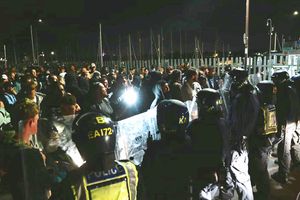 Officers injured and vehicles damaged during anti-migrant protest in Portsmouth - as police hunt suspects
 Four murder arrests after baby girl dies while camping with family in Staffordshire
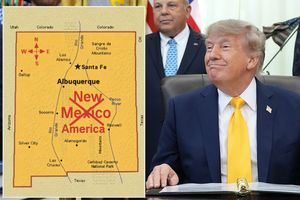 Trump posts map renaming New Mexico as 'New America'
 Man bitten by dog on Wakefield path 'died from complications of leg wound', inquest hears
 Oasis raise concerns over auction of unheard recordings archive