When Il-yong Ju was a child, something strange would happen in his tiny village in rural North Korea every December 25th.
His grandfather would visit and send him out to the mountains to cut down a pine tree. He would bring it home and small balls of cotton were hung on its branches.
In many countries, it's a familiar ritual: setting up and decorating a tree for Christmas Day. But in North Korea, December 25th is just another day and Christmas is effectively banned.
Ju said: "In my home, we just celebrated that kind of thing. But we didn't know what that day was about; just every December 25th, my grandfather asked us to do that.
"My grandfather taught us 'hey grandson, the other countries beside North Korea, every December 25th, they make this kind of tree and celebrate this day'."
Not knowing the origins of the tradition, his family displayed the tree openly.
The neighbours called it a "yolka" - a tree put up to mark the new year in the Russian-speaking world.
With Christianity being suppressed in North Korea, nobody knew the real origins of the tradition, and the family faced no repercussions, Ju said.
He explained: "It was possible because my village was a very small village. There were only 30 households living in my town, and it was very isolated from the main city."
The family would also clap and lead a chant. Its nonsense words sounded like "belly hem, belly hem, say goodbye, say goodbye".
What was the reason? Mysterious radio transmissions from across the border in South Korea offered a clue.
Those broadcasts would take Ju from the countryside of North Hamgyong Province to the White House.
"Me and my family actually listened to the illegal foreign radio broadcasting in North Korea," said Ju.
"We listened to the FEBC (Far East Broadcasting Company), which is South Korean Christian broadcasting. It's very clearly heard in North Korea in the very early morning.
"So that was the first moment that we heard about gospel and Christianity."
If the tree was tolerated, the radio was not.
Agents of the state would turn up unannounced and search the home, checking radios to see what frequency they were tuned into.
Ju said: "We had to risk our lives because we were listening to South Korean broadcasting that is highly prohibited in North Korea.
"If you get caught, you would go to political prison camp or even be executed, because it was Christian broadcasting.
"So every time we covered the window with a blanket and lowered the volume to prevent someone from hearing."
He continued: "That radio broadcasting was very impactful for my family.
"That radio was what motivated my father to escape from North Korea. He escaped first.
"When my father resettled in South Korea, he sent a broker to us. So me, my mother, and one of my sisters escaped in October 2009."
Escaping North Korea
Ju was just a child when he fled across the border to China, beginning a journey that would take him through three countries en-route to South Korea.
Staying at a missionary's house after crossing the frontier, he got some answers about this mysterious faith.
And on a cross-country bus through China, he embarked on a spiritual journey too.
He said: "On my bus, I did a sinner's prayer and received Jesus as a saviour."
Arriving in South Korea, where he can worship openly, Ju began to understand parts of his story in a new light.
That strange chant on Christmas Day?
"Belly hem was Bethlehem, and say goodbye was sacrifice," he said.
"My grandfather was trying to teach us about Christianity and Christmas Day."
He soon recognised other ways in which Christianity had breached the secure borders of North Korea.
He recalled a "funny story" told to him by a friend of his father about a man and woman in a garden.
"When I became a Christian, that story was exactly the same in the Bible," said Ju, now 29.
"That was actually the Garden of Eden, and Adam and and Eve's story."
Years later they were able to reach the man, still in North Korea, via a smuggled phone.
He revealed he was a missionary, who had converted to Christianity after crossing the border to China, and returned home to spread the gospel.
Ju knows only too well the risk he took in doing so.
He said: "My aunt and all of her family were sent to political prison camp, just because my aunt's grandfather-in-law was a Christian.
"When people get to that camp, they cannot come out until they die. So it's a slavery camp, and there is torture in there.
"We are still praying that my aunt's family are surviving there, but we cannot find them now."
Ju saw this tragedy play out again through his work with TIMJ, an organisation advocating for North Korean human rights.
"Some of the North Korean underground church members were working with us secretly," he said.
"A few of them got caught and sent to political prison camp, because they were caught sharing the gospel.
"Nobody knows whether they're alive or not."
Open Doors, a charity championing the cause of oppressed Christians worldwide, named North Korea as the country where believers face the most extreme persecution in 2025.
North Korea has topped the list every year since 2002, with the sole exception of 2022, when Afghanistan pushed it into second place.
Read more:
Ukrainian children 'sent to abusive camp in N Korea'
Trump '100% open' to meeting Kim Jong Un
"I think it's because Juche ideology, which is North Korea's ruling ideology, has many similarities to the Bible," said Ju.
"So if you just erase god and put Kim Jong-un, Kim Jong-il, Kim Il-sung on there, that is Juche ideology.
"So when people know about Christianity, I think the North Korean government is afraid that people would know that Juche ideology is a lie."
Meeting Trump
It's a message that Il-yong brought to the White House in 2019 when he met Donald Trump.
"I testified about Christian persecution in North Korea and I shared about my aunt's story," he said.
"I shared that even though the persecution is ongoing, people still worship there and they are craving freedom of faith."
In North Korea, December 24 is a public holiday, marking the birthday of Kim Jong-suk, the grandmother of Kim Jong-un and the first wife of Kim Il-sung - North Korea's founding dictator.
But Ju now lives in Seoul, South Korea, where Christmas Eve looks very different.
He said: "Every Christmas Eve, we gather at the church and we sing together, worship together, share meals together, and we prepare gift boxes and exchange them together."
"Normally I spend Christmas Day in the church with the church members."
He's even had the chance to experience Christmas in Britain.
He said: "The Christmas trees and neon signs were so pretty. I really enjoyed it. So beautiful."
And he's got a message for Britain this Christmas.
"When many people think about North Korea, the first pop-out image is nuclear weapons, Kim Jong-un, and famine," said Ju.
"But I really want to let people know that we need to pay attention to the people, not the regime."

(c) Sky News 2025: North Korea defector reveals what it's like celebrating Christmas in country where it's banne
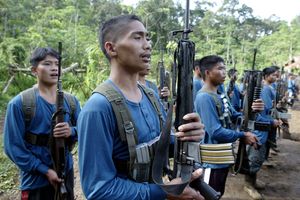 This 56-year conflict still pauses for Christmas
 White House orders US military to 'quarantine' Venezuela oil, official says
 Ukraine and US agree updated 20-point peace plan after Moscow hit by another deadly bombing
 Second fatal bombing in Moscow 'embarrassing' for Kremlin but helpful timing for Ukraine
 For Palestinian Christians, return of Christmas celebrations in Bethlehem mark opportunity to revive hope
 Families reunited with kidnapped Nigerian schoolchildren in time for Christmas