
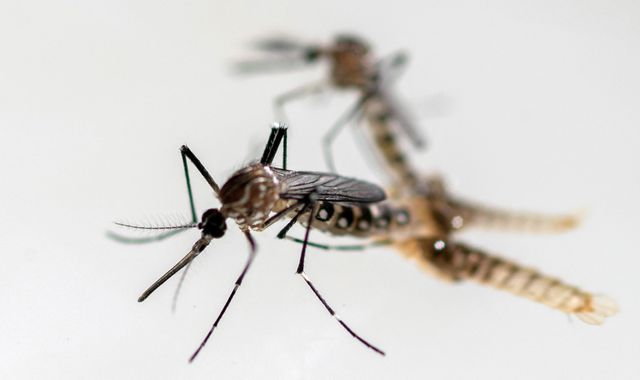
An invasive mosquito species known to transmit diseases such as the dengue and Zika viruses has been found to be breeding in the UK for the first time.
Aedes aegypti mosquitoes and their larvae were found at residential properties in east London, leading to the UK Health Security Agency (UKHSA) stepping up surveillance and trapping.
The discovery was made through the UKHSA Mosquito Watch scheme, and control measures have been put in place to destroy the larvae.
While the species has been detected on three other occasions in the UK in recent years, it has never been found breeding before.
Health officials said the risk to the public remains low and, despite recent heatwaves, the overall UK climate is too cold for Aedes aegypti mosquitoes to survive long-term.
Usually found in tropical and subtropical countries, the insects are known to "hitchhike" in vehicles, baggage and imported plants and can survive in suitable climates.
The species is a transmitter of viruses such as dengue, chikungunya and Zika.
Dr Jolyon Medlock, head of medical entomology and zoonoses ecology at UKHSA, warned the UK would continue to see cases of invasive mosquitoes and increased reports of them being able to survive in a warming climate.
He added: "There is no evidence that these mosquitoes have caused human infections [in the UK] and, importantly, to date, there is no evidence of the mosquitoes or larvae being detected in nearby public areas.
"We believe these mosquitoes are accidental importations."
The UKHSA said people could reduce opportunities for all mosquito species to breed by removing standing water from gardens, including water collected in buckets, containers and plant pots.
Read more from Sky News:
Pupil who stabbed teacher in the head sentenced
Woman who died in crash following police pursuit named
The only places these mosquitoes currently survive in Europe are in some parts of the Mediterranean.
Speaking about the discovery, Heather Ferguson, professor of infectious disease ecology at the University of Glasgow and lead of the Mosquito Scotland project, described it as "significant".
"To make sure these diseases do not pose a risk to the UK public in the future, it is important that this mosquito species does not establish in the UK," she added.
The UKHSA warns that incursions of other types of invasive mosquitoes - including the tiger mosquito and Aedes albopictus mosquito- will also continue, with the insects able to survive for longer periods as the climate warms.

(c) Sky News 2026: 'Hitchhiking' mosquitoes that can transmit dengue and Zika virus found breeding in UK
 Met Police chief 'flabbergasted' by release of knife and gun crime suspects on bail
 Patient lived with world's first pig kidney transplant for nine months before getting human organ
 Mike Dean admits he tried not to blow whistle during Premier League matches as a 'game'
 Trump avoids backing UK over Falklands, saying Britain 'not there to help' in Iran
 Two people arrested by German police over alleged arson attack on defence firm