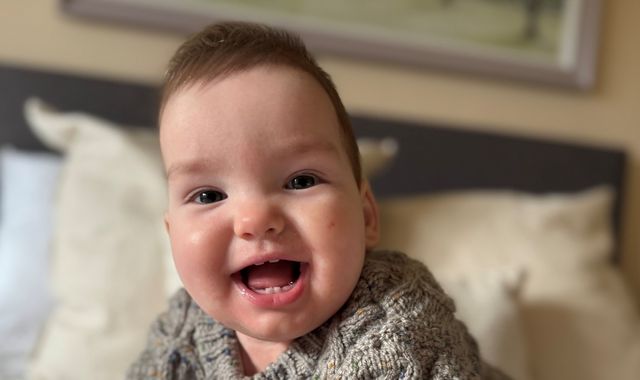
A baby boy has become the first in the world to receive a new type of treatment for a rare skull condition.
One-year-old Rory Potter was diagnosed with severe sagittal craniosynostosis shortly after being born - a condition where the skull fuses before birth which leads to the skull to be long from front-to-back but narrow from side-to-side.
Treatment usually involves skull reshaping surgery, which takes place within the first months of life.
Over the last two decades, this has involved using stainless steel springs to gradually widen the gap, giving space for the brain to develop and for new bone to grow.
However, experts at Great Ormond Street Hospital (GOSH) and University College London (UCL) have now developed new "super elastic" springs using a metal called nitinol - a nickel and titanium alloy - with Rory the first patient to have them fitted.
Each spring is custom-designed to the patient, with the device's "super elastic properties" allowing them to adapt more naturally to a child's growing skull, according to experts at GOSH.
A detailed digital model of each child's skull is created using CT scans to help predict how they will respond to surgery. Bespoke springs are then designed to deliver the right level of force.
Once inserted, the springs remain in place for several weeks, gradually reshaping the skull before being removed.
The new technology means children can avoid longer and more invasive operations and should see a reduction in blood transfusion rates, experts said.
'Happy, cheeky and full of energy'
Rory's parents, Harry and Jo Potter, from Chesterfield, Derbyshire, raised concerns about their son's head being longer than expected after his birth in April 2025.
Following his sagittal craniosynostosis diagnosis, Rory underwent the 45-minute operation to fit the springs in September last year.
Nine weeks later they were removed after his skull reached the desired outcome.
Ms Potter, who described her son as "happy, cheeky and full of energy", said: "You wouldn't know what he's been through, he's just like every little boy and hitting milestones and he will have a great story to tell when he's older.
"We cannot thank the team enough for the care, compassion and reassurance. Not to mention their dedication to medical science to support and help children thrive.
"Throughout the process, every element was explained so well. We knew what was going to happen and how, we received amazing support from each member of the team."
Read more from Sky News:
Northern Ireland has highest infant mortality rate in UK
Gallagher brothers unite for Oasis's UK documentary premiere
Professor Owase Jeelani, a consultant neurosurgeon at GOSH and part of the team who developed the new springs, said: "Traditional stainless-steel springs are very robust, but they don't always allow us to fine-tune the force on the skull.
"These new nitinol springs give us much greater flexibility and, in some cases, can prevent the need for further surgery.
"This first surgery is important progress for children with craniosynostosis and so far, we have seen fantastic outcomes."

(c) Sky News 2026: One-year-old given world-first treatment for rare skull condition
 Thieves steal three paintings from Renoir Museum on French Riviera
 Prince George set for first day at Eton College
 Noel and Liam Gallagher unite for Oasis's UK documentary premiere - here's what we learn from the film