Palestine Action's co-founder has won a legal challenge over the group's proscription as a terror group by the UK government.
The group was proscribed in July last year by former home secretary Yvette Cooper, making it illegal to show any support or affiliation to them.
It came after members of the group were accused of breaking into RAF Brize Norton and spray-painting two aircraft.
On Friday 13 February Palestine Action's founder Huda Ammori won a High Court legal challenge, but the group will remain outlawed for now as the government intends to take the case to the Court of Appeal.
Here Sky News looks at what proscription means, what effect it has, and how many other groups have the same status in the UK.
What is proscription?
Proscription is the banning of an organisation based on an assessment that it commits or participates in, prepares for, promotes or encourages, or is otherwise concerned in terrorism, the Home Office says.
The home secretary can choose to proscribe an organisation if it is found to do any of the following:
• Commits or participates in acts of terrorism
• Prepares for terrorism
• Promotes or encourages terrorism (including the unlawful glorification of terrorism); or,
• Is otherwise concerned in terrorism
Any move to proscribe the group must be debated and approved by MPs and peers.
When deciding to proscribe an organisation, the government takes into account:
• The nature and scale of an organisation's activities
• The specific threat that it poses to the UK
• The specific threat that it poses to British nationals overseas
• The extent of the organisation's presence in the UK
• The need to support other members of the international community in the global fight against terrorism
What does proscribing a group do?
It makes it illegal to show support for the proscribed group, with any offences punishable by a maximum of 14 years in prison.
Specifically, it is a criminal offence to:
• Belong to a proscribed organisation
• Invite support for a proscribed organisation
• Recklessly express support for a proscribed organisation
• Arrange a meeting in support of a proscribed organisation
• Wear clothing or carry articles in public which arouse reasonable suspicion that an individual is a member or supporter of a proscribed organisation
• Publish an image of an article such as a flag or logo in the same circumstances
The last two offences are less severe and punishable by up to six months in prison and/or a fine not exceeding £5,000.
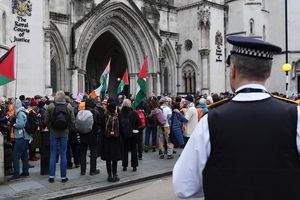
Since Palestine Action's proscription came into effect on 5 July, protesters have been defying the ruling by showing support at demonstrations in cities across the UK.
The Defend Our Juries campaign group, which organises protests against the ban, said 2,787 people had been arrested since it came into force.
Raza Husain KC, representing Ms Ammori in the legal challenge, said "priests, teachers, pensioners, retired British Army officers" and an "81-year-old former magistrate" were among them.
How many proscribed organisations are there?
There are now 84 organisations proscribed by the UK government under the Terrorism Act 2000, with Palestine Action on the same footing as ISIS and al Qaeda.
There are an additional 14 organisations in Northern Ireland proscribed under previous legislation, including the Irish Republican Army (IRA).
Read more:
Far-right incels and a Muslim who idolises Hitler: Britain's young extremists
The ins and outs of UK cannabis law - and calls to decriminalise it
Two other groups were proscribed in July last year along with Palestine Action:
• Russian Imperium Movement (RIM) - A Saint Petersburg-based ultranationalist and pro-monarchist organisation, which adheres to a white supremacist and ethno-nationalist ideology and seeks to create a new Russian imperial state.
• Maniacs Murder Cult (MMC) - A white supremacist, neo-Nazi organisation that is transnational and predominantly online. It aims to encourage individuals to engage in acts of violence against people that it perceives as "antisocial", including homeless people, drug addicts and migrants.
You can see the full list by clicking here.
Why did the High Court rule in favour of Palestine Action?
Ms Ammori's lawyers had argued the High Court move was unprecedented and compared Palestine Action - which she co-founded in 2020 - to the suffragettes.
In her ruling, Judge Dame Victoria Sharp agreed with the government's assessment that Palestine Action "promotes its political cause through criminality".
However, she said the ban was still disproportionate as it interfered with the Human Rights Act, specifically the freedom of expression and freedom of assembly.
Legal expert Joshua Rozenberg said the court had decided a very small number of the group's members carried out acts amounting to "terrorism" and these hadn't reached a level that warranted a blanket ban.
He said the court had also ruled the former home secretary's decision was in breach of her own policy at the time - but that it failed on two further grounds, including a claim that Ms Cooper should have consulted it before the ban.
Met Police said the group remains banned, "which means expressing support is still a criminal offence".
A statement said they would "continue to identify offences where support for Palestine Action is being expressed" but would "focus on gathering evidence... for enforcement at a later date, rather than making arrests at the time".
Ms Ammori called the ruling at London's High Court "a monumental victory both for our fundamental freedoms here in Britain and in the struggle for freedom for the Palestinian people".
Home Secretary Shabana Mahmood said she was "disappointed" and disagreed with the court that the ban was disproportionate.
She said she would appeal and the government had used a "rigorous and evidence-based decision-making process" when outlawing the group.

(c) Sky News 2026: Palestine Action is still proscribed despite court win - but what does that mean?
 Palestine Action wins High Court challenge over government's terror ban
 New snow and ice warnings issued across large parts of UK
 Man who tried to kill uniformed army officer in knife attack sentenced
 Extremists jailed for plotting 'deadliest' terror attack on UK Jewish community
 'Critical incident' declared at Nottingham University Hospitals